
As an Amazon Associate, we earn from qualifying purchases. This post contains affiliate links – if you buy through them, we may earn a commission at no extra cost to you.
There’s no single best optic for the Kimber 2K11 Pro. There’s a best one for a particular kind of shooter. Some folks want a big, easy dot they can pick up fast. Others want something that disappears on the slide. Your habits decide it. How often you’ll shoot, whether you carry it, and how much you care about a backup sight all matter here.
The listings differ mostly on size, how the dot is built, and what backup or power features they bring. Those are the things to look at first.
Comparison Table




Best forA shooter who wants a large, easy-to-see dot on a full-sized pistol.
This optic is an open reflex sight with a wide field of view. It has a 2 MOA dot, and the listing says the housing is 7075 aluminum. The buttons have a lock mode, so settings don’t shift by accident. That matters if the gun goes in and out of a bag or case a lot.
The solar failsafe and shake awake features are the other big points. The solar panel gives backup power when light is around. Shake awake turns the LED off when you’re not using it, and it wakes up with the slightest touch. The listing gives a battery life of up to 50,000 hours.
Good if: You want a wide window and a clear dot. Good if: You like a solar backup in case the battery fails. Good if: You want settings locked so they don’t change in your bag.
Skip it if: You want the smallest, flattest optic you can find.
Best forA first-time buyer who wants simple, dependable setup.
The Triumph has a crisp 2 MOA red dot and unlimited eye relief, so you don’t have to line your eye up perfectly. It has nine daylight settings and two night-vision settings. The listing says it powers on with motion and shuts off after 10 minutes, so you don’t have to remember to turn it off.
It comes with both a lower 1/3 co-witness mount and a low mount, so you can pick the height that fits your setup. The listing also backs it with a lifetime VIP warranty to repair or replace the item if it becomes damaged or defective.
Good if: You want easy setup with two mount heights to choose from. Good if: You want a long warranty that transfers if you sell the optic.
Skip it if: You need a dot that stays visible in bright sun. The listing doesn’t say how it handles that.
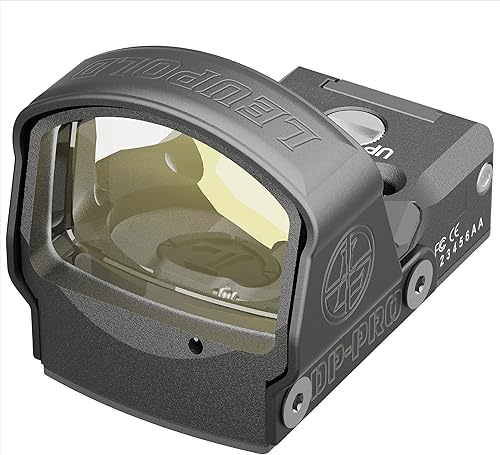
Best forA shooter who wants a sight built to last through hard use.
This is a 2.5 MOA dot with a matte finish. Leupold says it’s machined and assembled in the USA. The listing says it’s waterproof, fogproof, and shockproof. That kind of build is what you want if the pistol gets knocked around a lot.
The motion sensor shuts the illuminated reticle off after five minutes of no movement. It comes back on as soon as you move the gun. The listing also notes that the reticle is illuminated, which helps in dim light.
Good if: You want an optic that’s built to take a beating. Good if: You want a sight made in the USA with Leupold’s customer care behind it.
Skip it if: You want a red dot built for the most demanding use. This isn’t the one for that.
Best forSomeone who carries a compact pistol and wants a small, tough sight.
The ROMEO1PRO has a 3 MOA dot and 12 brightness settings. The listing says it has 20,000 hours of runtime. The housing is aircraft-grade aluminum, and the listing rates it IPX-7 for water immersion up to one meter. It also comes with a protective shroud in the box.
The big catch is fitment. It isn’t compatible with slides cut for a standard ROMEO1, and it isn’t rated for 10mm.
Good if: You have a compatible SIG slide and want a small, rugged sight. Good if: You like a shroud that protects the lens.
Skip it if: Your pistol isn’t on the compatibility list.
Best forSomeone who wants backup iron sights built into the optic itself.
This is the lowest-profile sight in the group. The rear iron sights are cut right into the housing, so there’s nothing extra to bolt on or zero. The 3 MOA dot has 10 brightness settings and a daylight mode for bright conditions. The listing says it uses shake awake, so it powers on when you draw and sleeps when you holster it.
The listing gives the weight as 4.66 oz and the housing as 6061-T6 aluminum rated IP64. The lens has anti-reflective and water-shedding coatings. It mounts directly to RMSc-cut slides, so no adapter plate is needed.
Good if: You want backup sights that come with the optic. Good if: You carry concealed and want the lowest profile.
Skip it if: Your slide isn’t cut for an RMSc footprint.
Where These Overlap
If you only compare those two features, they look close. The real difference is size and backup. The Triton has rear iron sights cut into its housing and weighs 4.66 oz. The Vortex Triumph and the Leupold DeltaPoint Pro differ in dot size and mounting options, so compare them on those.
Still Not Sure?
How often will I really use it?
If you shoot every week, a sight with a long battery life and a solid build makes sense. The Leupold DeltaPoint Pro is built for that kind of steady use.
What do I already own that this has to work with?
Check your slide first. The SIG Sauer ROMEO1PRO only works with certain cuts, and the Triton needs an RMSc footprint. If your slide is a match, both are easy picks. If not, the Vortex Triumph has two mount heights to fit more setups.
What am I most likely to regret choosing?
Most people regret buying the wrong footprint. Confirm the mount before you buy. If you want a simple, forgiving choice, the Vortex Triumph is the one to start with.
Related guides
- Best Red Dot for Taurus GX4: Top Optics for Precision Shooting
- 5 Best Optics for ZEV OZ9: Top Red Dot Sight Picks
- 5 Top Red Dot Options for XD-M Elite: Our Best Picks
Frequently Asked Questions
Do I need a special slide cut for a red dot on the Kimber 2K11 Pro?
Usually yes. Each optic has a footprint, and the slide has to be cut to match. The Triton Nautilus2 Micro and the Holosun 407C/507C-X2 both use a 407C/507C-style footprint, so check that your slide is cut for it. The SIG Sauer ROMEO1PRO has its own compatibility list, so check that before buying.
What is the difference between MOA dot sizes?
MOA stands for minute of angle. A smaller number means a finer dot. The Holosun and Vortex use the finest dot in this group, the Leupold is slightly larger, and the Triton and SIG have the largest dot. A smaller dot can help with precision, while a larger one is easier to find quickly.
Does a red dot need batteries?
Most of these run on a coin battery. The Holosun also has a solar panel for backup power when light is available. Shake awake or motion sensors on several models help the battery last longer when the gun isn’t in use.
Can I mount one of these without tools?
Most mounts need a screwdriver or a hex key. Check the instructions for your specific optic and slide before you start. The Vortex Triumph includes two mounts, which can help you find a fit that works.
Closing
If you carry a compact and want backup sights, pick the Triton Nautilus2 Micro. If you want a big, easy dot on a full-sized pistol, the Holosun 407C/507C-X2 is the one to look at. Before you buy either, confirm your slide cut matches the footprint.